
Tripping down Memory Lane in footie jammies
NOTE: Originally published in The Kansas City Kansan, this piece was the Oct. 8, 1999 offering for my weekly entertainment column, Crum on Film.
 By Steve Crum
Ah, memories. Maybe it is a sign of my increasingly elder age, but remembrances of my youth become clearer the older this Crum gets. As Cousin “Pud” Crum used to say of his long marriage: It seems like only yesterday, and you know what a lousy day yesterday was. Movies occupy multiple cells in my memory banks. Permit me to share some celluloid recall.
•Seeing The Robe in 1953—This 20th Century Fox spectacular was the first Cinemascope film, a process that was the most successful innovation by movie companies in the ‘50s to lure eyes and wallets away from TV and back into theaters.
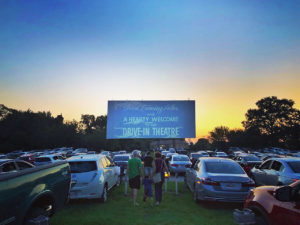
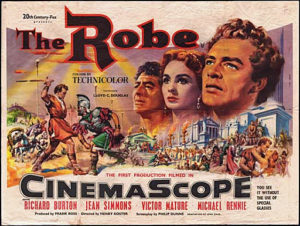 Then a mere lad of six, I dimly recall being taken either to either the Avenue or Electric Theater in downtown Kansas City, Kansas. This was one of the very few indoor all-Crum-Family movie going ventures. Limited by money, we usually went to an area drive-in movie.
•Watching my hero at Lake Park Drive-in, 1950s—The only specific movie memory at this location is 1955’s Davy Crockett, King of the Wild Frontier. Dad was very disappointed. Not long into the movie, he groused, “This is the same stuff we saw on TV!” True. Disney edited three episodes of the TV series starring Fess Parker into a 90-minute programmer. Smart movie too, since the movie made an Alamo-full of cash. I loved it nonetheless, since I got to see it in color for the first time. Also, I had (at home) my official Davy Crockett mock-leather and fringe outfit with mock-coonskin cap. Call me a mock-hero. Unfortunately, both Davy and sidekick Georgie (Buddy Ebsen) still died at the end, just like on TV. EXACTLY like on TV.
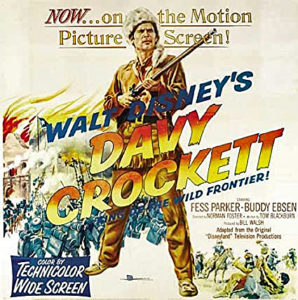 Incidentally, Disney had grossly misjudged the popularity of his Crockett three-parter. After killing off Davy in Part 3, Disney hurriedly produced two television prequel episodes which were also later edited and released to movie theaters. (Those two adventures focused on Mike Fink, King of the River.) Why Disney did not continue producing more Crocketts on TV (or films, for that matter) is a flabbergasting mystery. At least Fess Parker donned coonskins a few years later as Daniel Boone in a long running, non-Disney TV series. Parker is now a pudgy, white-haired winery businessman and former politician. (Update: He died at 85 in 2010.)
•Don’t forget those Lake Park Drive-In sensory details!—Mom, Dad, younger sister Becky and I would trek out to the movies equipped with freshly made popcorn and a thermos of Kool-Aid. Balancing our snacks in the back seat, my sister and I would strain to see over the tall front seats, around our parents’ heads, side-glancing the steering wheel, and through the limited front window portal. Dad always parked too angled-up at drive-ins, which made our view even more strained. No wonder we tired so quickly and fell asleep. Our little necks and backs were stressed. It was clearly chiropractic child abuse.
 Did I mention the jammies? My most feared inevitability was having to walk with my dad to the restroom at KCK’s Lake Park Drive-in while wearing my pajamas. And that was when I was 32 years old! Just joshing. I was a grade school kid, shy and insecure even then. Maybe if my jammies would not have had those footies and the trap door in back.
More starkly personal and overly revealing movie memories will follow in future issues.
—————
Classic adventure yarn,’The Call of the Wild,’ remains great family viewing
 By Steve Crum
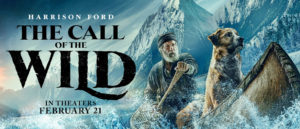
If The Call of the Wild often looks like a live action cartoon, there is good reason for it. The sled dogs, including the lead dog and film’s star, Buck, are indeed animated. (Buck’s backstory later.) Rest assured that their computer generated images are for the most part impossible to separate from the real thing. The CGI Klondike exteriors also appear remarkably real, even though the film was not shot on location in Alaska.
It turns out that The Call of the Wild is a very good action-adventure film based upon Jack London’s endearing 1903 novel. Although its PG rating is based upon some violence and peril depicted, the film is ultra suitable for family audiences.
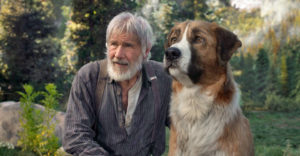 Harrison Ford stars as John Thornton, a bedraggled, white bearded prospector living in 1900 Skagway, Alaska, per se gateway to The Yukon and gold seekers. Ford also infrequently narrates. He does fine on both counts, particularly when displaying kind and protective love toward his canine companion, Buck.
The film serves as the live-action directorial debut of Chris Sanders—of the animated How To Train Your Dragon fame. Adapting London’s novel is Michael Green.
 Another first for this movie is the opening logo. The decades old 20th Century Fox Fanfare is heard, along with the familiar searchlights. But the “Fox” is forever gone, replaced by “Studios.” Henceforth, it will be “20th Century Studios.”
The movie’s premise involves a lovable adult St. Bernard/Scotch Collie dog, Buck, who we see at the opening as the clumsily destructive family pet of an upper class family in Santa Clara, California. Buck is dognapped and sent with freight haulers to Alaska. Top dollar is paid for dogs there since snow sleds require canines as team pullers. What Buck lacks in Husky dog prowess, he makes up for in stamina and intelligence. He can also be vicious in self defense.
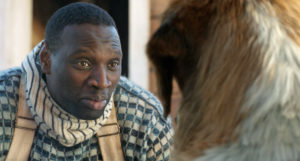 And he is loyal to his friends, both dogs and humans. Enter John Thornton, who befriends Buck after he helps the dog escape from cruel captors. At first, Buck’s life in the snow and ice includes multiple masters and mishaps after being force trained to work with a dog team. Actors Dan Stevens, Omar Sy, Karen Gillan, Bradley Whitford, and Colin Woodell round out a cast that crosses tracks with the once incorrigible Buck.
As the story proceeds, Buck also confronts a bear and wolves—emphasis on the latter. All are CGI’d. It is with them that Buck plays out the film’s title. Speaking of the title, which retains Jack London’s, this story has been told on screen multiple times in both full animation and live action. There was even a best selling Classics Illustrated comic book adaptation. Charlton Heston had a go at the Thornton 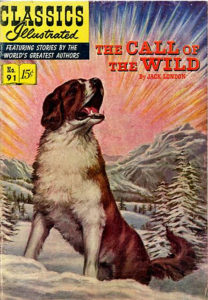 character in 1972 as did Clark Gable (1935). Sadly, Gable’s version, directed by William Wellman, only uses Buck’s story as secondary to a love story involving Thornton.
However, this 2020 take is much closer cloning to London’s novel in that Buck is THE central character. Thanks to CGI, we can almost read his mind via body language and facial expressions. That goes for the other animals as well. They convey thoughts and emotions through subtle pantomime. Still, I was at times convinced Buck and his cronies WERE real. It is an amazing technical accomplishment recently used in Disney’s The Jungle Book (2016) and The Lion King (2019).
——-
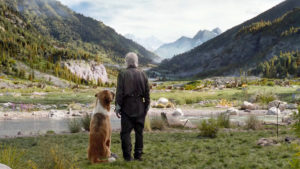 As postscript, the CGI model for Buck is also named Buck—for Buckley. Seeking to find the perfect model for Buck, the film’s production team met success via a stray St. Bernard housed at an animal shelter in Emporia, Kansas. The cool capper is that director Chris Sanders and his wife, Jessica, then lovingly adopted Buck as their own.
A happy ending.
=====
GRADE, On A to F Scale: A-
Acting, passionate storytelling deliver disturbing, courageous ’Just Mercy’
 By Steve Crum
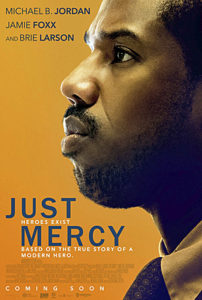
A legal drama about a vicious killer who has been a scourge for the past six years on death row? No. Just Mercy is based upon a true story about a totally innocent man who was housed on death row before he was even convicted. And found guilty based upon falsified “evidence.” This above average movie deals with racism, a corrupt prison system, and determination. Like other films of this ilk, the audience’s shock, disgust, and anger grow as the story progresses.
Think about other movies focused on a wrongly accused prisoner, and how frustrated we feel as the subject has to undergo harsh treatment strung out over many years. What comes to my mind is 1999’s The Hurricane, starring Denzel Washington as Rubin “The Hurricane” Carter, who spent 20 years in prison after being falsely convicted of murder.
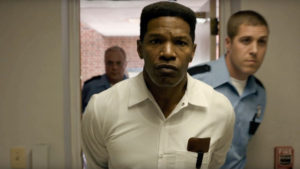 Just Mercy is all about Walter McMillian (well played by Jamie Foxx), a family man driving home in 1987 rural Alabama who is stopped on the highway by police for murdering a local 18 year-old girl. He is rushed to judgment by essentially a kangaroo court that assumed he was guilty, sans any credible evidence. It is strongly implied that being African-American weighed against him.
=====
Aside: Is it just coincidence that in movies, seemingly 90% of the time, wrongful treatment of African-Americans occurs in either Alabama or Mississippi? This time it is Alabama burning.
=====
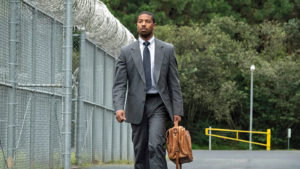 Discovering McMillian’s plight is novice defense attorney Bryan Stevenson (Michael B. Jordan), who immediately moves for an appeal trial. Aided by local advocate Eva Ansley (Brie Larson), Harvard Law School grad Stevenson butts heads with the local police chief and city attorney. They both played a huge part in sending Stevenson to prison six years earlier.
Jordan and Foxx are impressive actors, but so is Tim Blake Nelson’s sniveling prison lifer, Ralph Myers. It is Myers’ testimony that led to McMillian’s guilty ruling. Incidentally, what a convincing facial contortion Nelson creates.
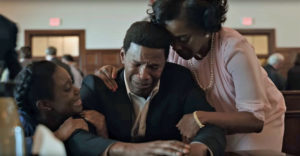 Without spoiling major plot twists, rest assured that McMillian does get his second trial in court. But that occurs quite a while before the film’s finale. Enough said.
Director/Co-Screenwriter Destin Daniel Cretton’s heartbreaking account of Walter McMillian’s imprisonment is based on Bryan Stevenson’s best selling book, Just Mercy: A Story of Justice and Redemption. Running 136 minutes, Just Mercy is well worth seeing. It is films like this that have helped cause positive change in our country’s court system.
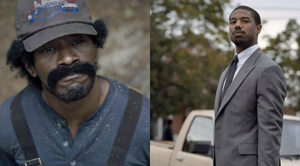 Mention should be made that the setting of Just Mercy is Monroeville, Alabama. As shown in the movie, Monroeville proudly touts itself as the home of To Kill a Mockingbird author Harper Lee.
That is the irony, of course, since Lee’s book centers on the trial of Tom Robinson, an African-American wrongly accused (of rape), and sent to an Alabama prison.
=====
GRADE, On A to F Scale: B
‘1917’ reigns among the best WWI films of all time—with good reason
 By Steve Crum
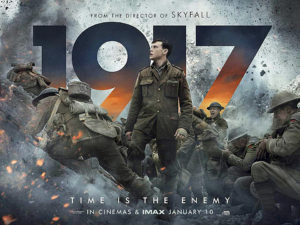
Sam Mendes’ 1917 is arguably among THE best movies set during WWI ever produced. That exclusive list includes All Quiet on the Western Front (1929), La Grande Illusion (1937), 1960’s Paths of Glory, Wings (1927), and War Horse (2015). 1917’s plot involves a 24-hour life or death mission ordered to two British soldiers. As such, the film is so much more plotted than firing and dodging bullets.
1917 is about humanity, fear, heroics, death, hope, and brotherhood. That last one is particularly apt in regard to 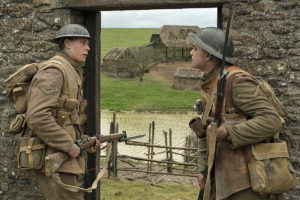 the two soldiers who are 1917’s central characters.
Co-writer Sam Mendez (American Beauty, Skyfall), who also directs and produces, has fashioned a touching and dynamic tale of two British Lance Corporals given the near suicide assignment of delivering a message to British forces sequestered in in a humongous trench miles away. The two must cross enemy German lines (“No Man’s Land”) to save the lives of 1,600 British troops. Lance Corporals William Schofield (George MacKay) and Tom Blake (Dean-Charles Chapman) were particularly chosen since Blake’s older brother, a lieutenant, is among that battalion to be alerted. The message warns of stopping the planned attack on Germans since the Germans have faked their retreat only to lie in waiting for their own surprise attack. As their CO, General Erinmore (Colin Firth) 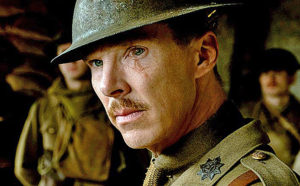 informs them: “They’re walking into a trap. Your orders are to deliver a message calling off tomorrow mornings attack. If you fail, it will be a massacre.”
Incidentally, the planned recipient of the message, Col. Mackenzie, is portrayed by Benedict Cumberbatch. He and Firth are the only recognizable names in the cast…and they are in very small parts. However, relative unknown George MacKay should attain significant 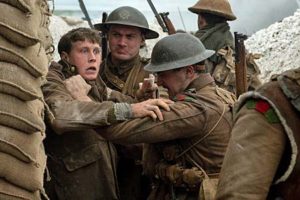 star status due to his terrific acting. It is essentially a solo, star spotlight for him.
Mendes based this nearly two hour war drama on stories told to him by his late grandfather, who served with the British Army in WWI. That said, his fictional 1917 work is both credible and incredible. What an adventure.
Within the day’s journey, the two corporals encounter rotting corpses hanging on barbed wire, rats, corpses in ditches, booby traps, snipers, corpses in abandoned buildings, airplanes dogfighting, floating corpses, and the enemy—face to face. The kindness and sensitivity to fellow humans is also shown.
Specifics, as well as the memorable conclusion, will not be divulged here.
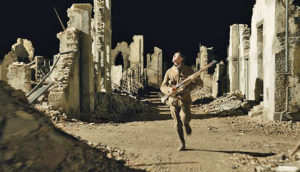
But mention must be made of Roger Deakins’ superb cinematography. His visuals are a wow. Who will forget those night scenes in the bombed out French village that appear surreal and nightmarish? The incredible long, long shots of walking and running through the lengthy trenches were accomplished via extended takes and sharp editing by Lee Smith.
Thomas Newman’s moving score is also a plus.
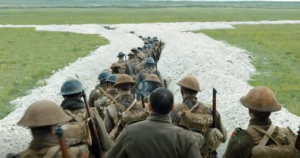 The realism of 1917 is accentuated by filming locations in Scotland and Great Britain. Harking back to the pre-digital effects days, some shots utilized as many as 500 background extras.
Both 1917 and Mendes recently won Golden Globes as Best Picture and Director. Why stop here? The Oscars are just around the proverbial corner.
=====
GRADE, On A to F Scale: A
42 years later, ‘The Rise of Skywalker’ brings ‘Star Wars’ saga to spectacular, heartfelt finale
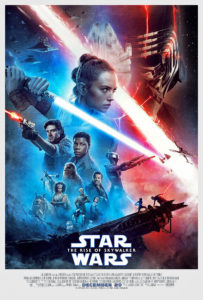 By Steve Crum
For a Star Wars fan like myself (I still have the original 1977 program sold in the lobby), screening Star Wars: The Rise of Skywalker was both a proverbial labor of love AND a duty. My fervent anticipation of a new Star Wars flick was still flickering. Per se. However, News Flash: This grand finale to the “Skywalker Saga” nine films is a must see, but a bit disappointing.
Credit J. J. Abrams, who co-wrote, co-produced and directed this episode as well as episode 7, The Force Awakens, in 2015. In his defense, it was a daunting task to tether all the plot lines and character elements into a cohesive conclusion. Think of all the characters from Luke Skywalker to Darth Vader to Palpatine to Kylo Ren and Rey. Then there are the robots, storm troopers, brothers and sisters (Luke and Leia), husbands and wives (Han and Leia), and various planet inhabitants. If it sounds like a bulk of beings to squeeze into 142 minutes, it is because it is. As a result, one has to look fast and wide to glimpse the many cameos and walk-ons.
The end result is an obviously huge scale action-adventure tale with state of the art effects and sparse time for good natured joking and character development. Then again, why is character development necessary? In most of the movie, it isn’t  needed. We already know these people, these creatures, these robots. However, major characterization change does occur with two of the principal characters: the last Jedi Ren (played by Daisy Ridley); and Kylo Ren (Adam Driver), the Supreme Leader of the First Order and son of Leia Organa (Carrie Fisher) and Han Solo (Harrison Ford).
To summarize the overall plot, using studio publicity, The Rise of Skywalker takes place “a year after the events of The Last Jedi. The 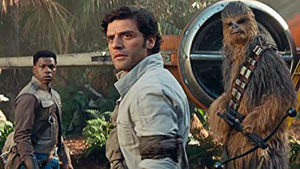 remnants of the Resistance face the First Order once again—while reckoning with the past and their own inner turmoil. Meanwhile, the ancient conflict between the Jedi and the Sith reaches its climax.”
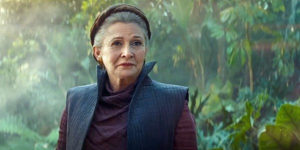 It is good seeing Carrie Fisher return as Leia, albeit via clever editing and unused footage from The Force Awakens. (Fisher died in 2016.) And 82 year-old Billy Dee Williams has more than just a line or two in his return as Lando Calrissian, the original owner of the Millennium Falcon.
Richard E. Grant, last year’s Best Supporting Actor Oscar winner for Can You Ever Forgive Me?, displays his evil chops as First Order General Pryde. The long list of Star Wars returnees includes Mark Hamill (Luke Skywalker), Oscar Isaac (Poe Dameron), Anthony Daniels (C-3PO), Lupita Nyong’o (Maz Kanata), Ian  McDiarmid (Palpatine/Darth Sidious), John Boyega (Finn), and Joonas Suotamo (Chewbacca).
Spoiler Alert: There are some surprise characters returning as well as some surprise deaths. That’s all I will reveal….except to look for a sea of quicksand.
Oh yes, let us not overlook composer-conductor John Williams. The brilliant 87 year-old came out of retirement to score yet another Star Wars movie.
Star Wars: The Rise of Skywalker lacks the outright fun and originality of the previous episodes, but it achieves its goal of providing big scale closure.
=====
GRADE, On A to F Scale: B