
Author: Steve Crum
‘Horizon’ is majestic in scope, but major disappointment
 By Steve Crum
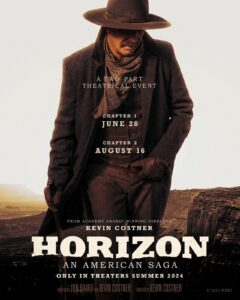
Kevin Costner’s epic western, Horizon, should have been better. It saddens me to say such because I am both a huge fan of the western genre plus a Costner fan. His Dances With Wolves remains an all-time classic.
But now comes Horizon.
Horizon, officially titled Horizon: An American Saga—Chapter 1, is a sprawling (in the true sense) 181-minutes. To be fair, it is difficult to judge the film since it is only 1/4 of the whole story. Yes, there are four, count-em, parts—three yet to be released. Although there are some interesting set pieces in this first chapter, like dissent among the Apaches and lawlessness among the Whites, this Horizon is a character study setting up future developments in plot.
One can only imagine the progression of plot among the multitude of characters introduced. Among them is, of course, Kevin Costner, who produced, co-wrote, directed and stars. His Hayes Ellison is a Montana 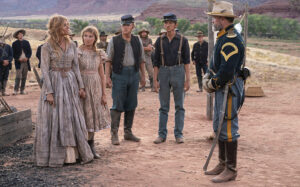 territory horse trader who gets mixed up with a prostitute and murder.
Others in the basic cast of 40+ include Sienna Miller, Sam Worthington, Giovani Ribisi and Michael Rooker.
The storyline centers on Westward migration during 1859 in the Arizona Territory. Handbills advertise settlement in the newly established town of Horizon. Homesteaders are enticed to settle, 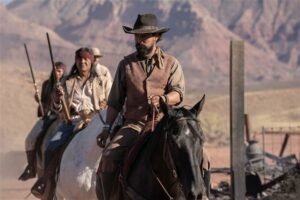 despite opposition of opposing Apaches. Of course, the impending danger of such is definitely not mentioned on any advertising circulars. Fast forward to 1863 with the basically tent city burg of Horizon celebrating their new land as Native Americans making armed opposition. A graphic slaughter of men, women and children ensues.
What follows is retaliation by the cavalry stationed at nearby Camp Gallant as well as greedy, scalp hunting ruffians. The story develops into romances and jealousy at the fort. Cut to Montana violence, life in a railroad work camp, a Santa Fe Trail wagon train, and relentless revenge against Native Americans.
 The aforementioned plot lines have been covered in many aspects since the beginning of the western genre. Costner has emphasized realism and in depth characters in his telling. I really like Costner touches like peering out of a distorted glass window—realistic for that time. In a similar vein, part of a gunfight is via the reflection in a water trough.
Costner is impressive, as are J. Michael Muro’s cinematography and John Debney’s score. Acting  overall is exemplary.
The picture ends with collage snippets of scenes in the upcoming Horizon—Chapter 2.
Although Chapter 1 pretty much failed at the box office, much to Costner’s and my chagrin, the second part is indeed planned for a 2025 theatrical release.
—————
GRADE on an A-F Scale: C+
Taut ‘Rebel Ridge’ is formula done so well
 By Steve Crum
When former Marine Terry Richmond cycles into a small Louisiana town, it should seem very familiar to action movie fans. The deja vu is because ex-Green Beret John Rambo entered a near-clone looking city in 1982. Back then, the success of Sylvester Stallone’s Rambo character initiated a string of movie sequels. Now, 42 years after First Blood, we have Rebel Ridge. It is a taut, action-packed thriller starring Aaron Pierre as Richmond. And it is well worth seeing.
Richmond’s protagonist is the burg’s police chief, with an uncharacteristic Don Johnson seething violence as a corrupt top cop. (Rambo’s nemesis was the town sheriff played by Brian Dennehy.) In both films, a strong, good guy, out-of-towner is totally unwelcome to law enforcement.
 All that said, director/writer Jeremy Saulnier does a slightly fabulous job in making the plot surprisingly fresh and compelling.
After being virtually robbed of his $36,000 (by two local cops) that he brought to help his jailed cousin, Richmond gets zero help from all concerned at police headquarters. Instead, he gets blowback from Chief Sandy Burnne (Johnson) and his underlings. But there is one sympathetic to his cause who faces danger if she takes Terry Richmond’s  side. She is Summer McBride, played by AnnaSophia Robb. Her decision to buck the corrupt legal system of Rebel Ridge and help Richmond threatens her life. Soon the two become a crime busting team.
The script’s credibility goes to surprise extremes whereby the two heroes scheme and fight Chief Burnne and his legalized thugs. Realize that Richmond is no Rambo—in the sense that Rambo is a one-man army. Actually, Terry is trying to avoid violence. At the same time, he has to become physical when helping his new comrade stay safe and survive.
Rebel Ridge’s third act is nail-gnawing intense as the forces of good and evil meet resolution. I know it sounds formula, but it works.
Incidentally, David Gallego’s cinematography is above average and worthy of note.
 Calling Terry Richmond a thinking man’s John Rambo is apt.
—————
GRADE on an A-F Scale: A-
20th Anniversary of ‘E. T.’: Still call waiting after two decades
This movie feature originally appeared in The Kansas City Kansan newspaper on March 23, 2002. My original artwork is included.

By Steve Crum
The rumors lie. The vulgar words have not been cut out of the 20th anniversary re-release of E. T. the Extra Terrestrial. So “penis breath” and a couple of other mildly off-color remarks made by the film’s children survive. It wasn’t a big deal in the first place, but there were publicity leaks that director Steven Spielberg, along with screenwriter Melissa Mathison, had cleaned up the language in what many consider his greatest motion picture work.
 Be that “breath” as it is, this new take on E. T. is barely changed from the original. The audios and visuals have been digitalized, although I could not discern a difference. Of course, I need to re-see the 1982 original to really compare. But there is a notable scene cut from the original release that IS noteworthy.
The restored gem occurs as Elliot (Henry Thomas) talks on the phone as the stumpy E. T. teeters on the edge of a bathtub in the background, and soon falls in. 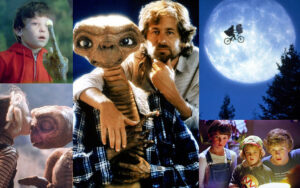 Elliot runs to rescue his friend, followed by E. T. wanting to remain submerged. It’s a cute, laughable scene.
At this point, forgive me. In my haste to divulge the scoop on changes in E. T., I assumed that most of you readers have already seen the movie at least once over the past 20 years, either on screen or video. For those who are in the minority, let me fill you in.
E. T. tells the story of a 10 year-old California boy, Elliot (Thomas), who one day befriends an outer space creature hiding in his backyard storage shed. The short and harmless visitor is stranded on earth after his fellow aliens take off in their space vehicle without him. It is established early on that the outer space botanists land on earth to collect plant specimens for storage in their ship’s greenhouse.
After enticing the thing in the house and upstairs into his room (all by leaving a trail of Reece’s Pieces), Elliot soon confides with his older brother, Michael (Robert MacNaughton) and six year-old sister,  Gertie (Drew Barrymore). Together, throughout most of the movie, they keep their house guest a secret from their mom (former Kansas City, Kansas resident Dee Wallace-Stone).
As government scientists zero in on the whereabouts of E. T., Elliot find that he emotionally links with the creature—with both comedic and dramatic results. Still a jaded laugh after all these years is when E. T. gets into the home refrigerator while Elliot is at school in science class. As E. T. chugs beer after beer, becoming falling-down drunk, Elliot experiences like results.
 By the time astronaut-suited scientists surround Elliot’s house (reminiscent of the home invasion in Spielberg earlier Close Encounters of the Third Kind), E. T. has learned to talk: “Phone home!” Time for Elliot and family to get their new pal back to his own planet.
There is a notable presence of the “Keys” character (Peter Coyote), who is shown waist down from the opening of the film, with a set of keys dangling off his belt. He is the leader of these government hunters, who are interestingly depicted as villains. Incidentally, Coyote’s character is shown full body and face at the end.
The tear-wrenching, Oscar-winning score by John Williams is as effective as ever, and E. T.’s eventual departure still grabs.
In its ending, which echoes sentiments similar to those in The Wizard of Oz, E. T. extolls the virtues of being home…and of loving one’s home. Elliot’s home has been torn by separated parents; and E. T. is separated from his own. Man’s humanity to his fellow man (or creature) is central to Spielberg’s best work—from Schindler’s List to A. I. to this genuine classic, his most popular film.
°°°°°°°°°°
GRADE on an A-F Scale: A
THE KANSAS CITY JOLSON STORY…Part 7: “ROBINSON CRUSOE, JR.”
 By Steve Crum
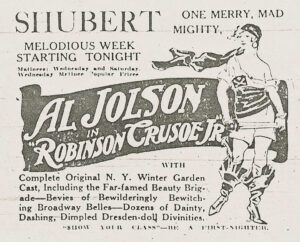
After “Robinson Crusoe, Jr.” had its initial, New York, Winter Garden run, Feb. 17-June 10, 1916, the national run began. From Aug. 28, 1916 through Nov. 17, 1917, Jolson’s show was enjoyed in dozens of American towns and, en route, a couple of Canadian cities. Audiences heard Jolson’s newest songs, along with what had already become his classics. During “Robinson Crusoe, Jr.’s” run, Jolson sang “Where the Black-Eyed Susans Grow,” “Down Where the Swanee River Flows,” “Yaaka Hula Hickey Dula,” and–naturally–”Where Did Robinson Crusoe Go with Friday on Saturday Night?”
Kansas City audiences jammed the Shubert Theater throughout “Crusoe’s” May 6-13, 1917 run. They could not get enough of their Al. Except for brief advance stories about “Robinson Crusoe, Jr.” opening, there were no local reviews or interviews 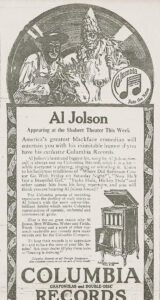 published.
However, a huge, Columbia Records display ad, which ran while the show was in town, depicts Jolson in his Gus Jackson/Friday character, in blackface, beside what appears to be the Robinson Crusoe character. The ad promotes “Al Jolson’s latest and biggest hit, sung by Al Jolson himself….”
A display ad for the show itself has only a chorus girl pictured, but AL JOLSON is listed above the show’s title for the first time–at least in KC. #
°°°°°°°°°°°°°°°
Head and shoulders etching of Mabel Wotten, followed by advance blurb:
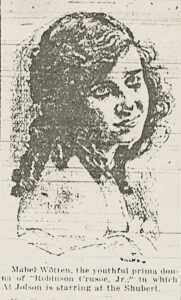 Mabel Wotten, the youthful prima donna of “Robinson Crusoe Jr.,” in which Al Jolson is starring at the Shubert.
THE KANSAS CITY JOLSON STORY…Part 6: “DANCING AROUND”
 By Steve Crum
Al Jolson was 29 years old when he played KC in Oct., 1915. The Shuberts’ touring show, “Dancing Around,” this time billed Jolson’s Gus character as “a man of many parts.” Jolson’s song repertoire included “When the Grown Up Ladies Act Like Babies,” “Sister Susie’s Sewing Shirts for Soldiers,” and “Everybody Rag With Me.”
After the 12-scene “musical spectacle” made its Broadway run, Oct. 10, 1914-Feb. 13, 1915, “Dancing Around” toured the USA (and Canada) from Feb. 15 to Dec. 4, 1915–pretty much the entire year. Traveling south after two days in Omaha, Jolson and troupers played to Kansas City audiences, Oct. 3-9, before heading to St. Louis.
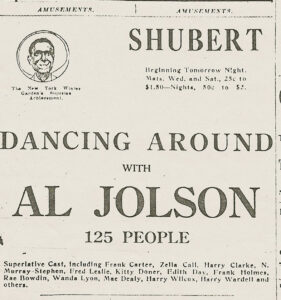
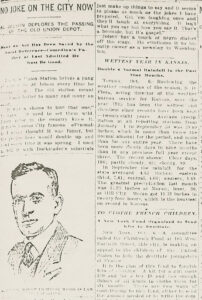 In a KC Star article published Oct. 6, “No Joke on the City Now,” Jolie laments the demise of Kansas City’s Union Depot (and what it means to comedians), and reminisces about playing in KC with Dockstader’s Minstrels. That is a rather stately looking pose of Jolson in the article’s engraving. A more typical Jolson pose, in blackface, is included within the display ad. Jolie is labeled, “The New York Winter Garden’s Surprise Achievement.”
Oct. 6, 1915 [in town for DANCING AROUND]
Interview:
NO JOKE ON THE CITY NOW
Al Jolson deplores the passing of the old Union Depot
———-
Many an act has been saved by the local reference–comedian’s father at last admitted he must be good
———-
The old Union Station brings a pang of sorrow to Al Jolson every time he thinks of it. The old station meant bread and butter to many and many an actor.
“It was a shame to lose that one,” he says. “It used to set them wild. Every actor in the country knew it. It made Kansas City famous. Personally I never thought it was funny, but the people here would double up howl every time it was sprung. I used to tell it with Dockstader’s Minstrels when we played the Grand ten years ago. If an act was going flat, a reference to the Old Union Depot would save it. The poorest comedian in the world could bring them up out of their seats with it. It was a scream.
“I don’t know why people laugh at local jokes, but they do. My idea of fun is to get into a joshing frame of mind with the audience and work to win a group, if they warm up to you. I wish I had confidence in myself, but I haven’t. Really, I’m always afraid they’re not going to like me, and if I do flop at any performance I’m no good for three days.”
SHY ABOUT HIS OWN FACE
Jolson is a boyish chap of 29. He’s been married eight years and he got his start in burlesque and from there went on to minstrelry, vaudeville and musical comedy. In New York he frequently appears on stage in white face, but is timid about trying it in the West, where he is not so well acquainted.
“Sometimes I think I must be fooling the public,” he remarks. “I can say without egotism that I usually keep them laughing, but I don’t understand it. When I was in vaudeville I showed my father my contracts, week by week, for each house. I was getting two or three hundred dollars a week then and it dazed him. After he’d looked them all over he looked me up and down from head to foot. ‘Al,’ he said, ‘you must be good, they can’t all be crazy.’
“You know, I think I’m developing a temperament. Honest I do. It used to be they could unload a ton of scrap iron back stage when I was working and I’d shout a little louder to drown the noise and never mind it. I thought I was good then. The other night a man came in late, and when I saw him coming down the aisle it sent me up in the air. I almost blew up. If that isn’t temperament, what is it?”
AUDIENCE MAKES HIM WORK
“Another thing, I’m against the movies. I had a big offer to go into the pictures but I turned it down. Imagine me up there trying to be funny with nothing in front of me but a man turning a crank. I wouldn’t do it. You can’t act without an audience. I like a friendly, human crowd out in front, and it’s no joke–I’ll work my head off. That applause stuff gets to me. They can all say they don’t like it and all that, but it sure puts the ginger in me. Another thing, I never pick out a funny looking man in the audience and try to kid him. The fresh actor makes more enemies than he does friends. Half the time I just make up things to say and it seems to please as much as the jokes I have prepared. Get ‘em laughing once and they’ll laugh at everything. It isn’t what you say but how you say it. That’s a bromide, but it’s gospel.”
Jolson has a touch of negro dialect off the stage. He attributes it to his early career as a newsboy in Washington.
#